Pulling at Red Threads
Celebrating two years of the Colorphilia Newsletter.

This two year anniversary issue of the Colorphilia newsletter has everything.
- The bold assertion that everyone is wrong.
- A crazy theory.
- A rabbit hole.
- A celebration of science and innovation.
- Senseless violence and brutal murder for the sake of color.
- References to champagne, religion, and nearly a dozen previous newsletters.
- And a list of comparative biblical translations.
If you haven't subscribed yet, please subscribe now. If you are on a free subscription, please consider upgrading to a paid one, or at least the occasional tip. And if you are gracious enough to have a paid subscription, thank you for your support.
Generally Accepted Narrative
If you open any single dictionary or encyclopedia, it will inform you, without question that grain or coccus is associated with kermes or cochineal, various insects used to dye fabrics red since antiquity.
Kermes was found in the Mediterranean, and most cochineal, which was considered a superior dye, was found in the New World. (There was also Polish cochineal, but for the purposes of this discussion, it is highly unlikely to have been the main source of dye for centuries.)
As the story goes, most Europeans had no idea that this dye was from made from insects. If they would even see the dye, it would appear as kernels or grains.
Around the year 1000 CE, Europeans even had assumed that the dye was made from some Murex rock snails, similar to the Bolinus brandaris, Hexaplex trunculus or Stramonita haemastoma.
After their brutal colonization of Mexico around 1521, the Spanish never wanted to let anyone else know that the cochineal was from, and they maintained secrecy over the entire process of production.
And yet, any time I come across any reference to a pre-16th century grain, historians are convinced that this is referring to kermes.
Reconsidering the Facts
It's been two years since I began writing this newsletter, and I have had several theories about this. I was convinced that they had used pomegranate seeds in dyeing, hence "grains". I even thought that all pigments could be referred to as grains, though I wasn't really able to qualify how. But I couldn't prove either.
There is a simple reason why I keep searching for an alternative understanding of the word grain or coccus. As a historian, the narrative does not make sense.
If every pre-16th century European reference to scarlet or grain really refers to kermes, where did it all come from? Why don't we have receipts and sources about the industry that produced the dye? There would have been tariffs paid. There should have been shortages during wars and conflicts.
We see that there was a strong late Medieval fabric industry in Flanders and Northern France, and to a lesser extent, in England. They grew woad (blue), madder (red), and dyer's weed (yellow). Basic economic theory dictates that people develop industries around locally available resources. They didn't have any special access to kermes. Especially not at the levels they would need to produce the fabrics at the levels they had maintained for centuries.
With all the war and religious conflict, piracy and thievery, and taxes and tariffs, it is completely illogical to assume a secretive, consistent supply chain of kermes that no one has ever discovered. And yet, every single dictionary and encyclopedia is certain that every mention of grain, scarlet, or coccus is referring to this dye. All because an etymological quirk which connects these insects to grains.
There is a reason why the Italians and Spanish bought fabric from the Flemish and Northern French, even when both the Spanish and the Italians would have likely had more access to actual kermes, either through local sourcing or trade.
Please note: This is not about fanciful references in literature. This is about the clothing that real people would order and wear. That would be given to brides as part of their wedding trousseau.
Theory
The problem, especially with natural dyes, is that their color didn't hold without help of other substances. And the grain that everyone wanted wasn't kermes, it was mordant. Mordant was usually a salt (like alum) which could be used to treat wool and fabric to make their natural dyes more colorfast.
And I've already written about how salt, sand, dust, and grain are all linguistically connected historically.
 Ezra Butler
 Ezra Butler
 Ezra Butler
Alum
As you'll see below, alum was important enough for the great patron of art, Lorenzo de' Medici, to orchestrate a "savage siege and sack of Volterra" in 1472, which included vicious rape and countless senseless murders, to gain control over mines there. And even after all that, they abandoned the mine.
Cream of Tartar
And the great 15th century French dyer, Jehan Gobelin, didn't build his legacy of beautiful colors reliant on materials from Spain or Turkey or beyond, he did so using locally-sourced potassium bitartrate to produce a more vibrant dye.
Simple Meanings
When something was said to be dyed "in grain", it meant they used a mordant first. When something was said to be "double dyed", it would be initially dyed with woad, and then again with madder. This is obviously minimizing a complex, arduous, and odiferous process.
Art & Science
Dyeing is both an art and science. The constant focus and insistence of scholars referring to non-native materials undermined the innovation the industry was able to accomplish. With some plants and a byproduct of wine, they were able to create a fabric which would rival the esteemed Royal Purple, which required the sacrifice of countless rock snails.
Reminder
I've already written about the (Judeo-)Arabic origins of the word scarlet.
 Ezra Butler
Rabbit Hole
How did I arrive at this theory? I had several loose red threads that I kept pulling at, and was not quite certain how they are connected.
- It's been a year since I researched tulips, and a few months since I came across the English word tuli, as a name of red fabric, as well as the occupation of someone who worked with the dyeing of red fabric.
- People seemed to assume that tuli was a red fabric which came from Toulouse, the city we know as La Ville Rose ("The Pink City"). Toulouse seems to celebrate their history with pastel (woad, blue) and not this fabric or dye. In the 14th century, there were reports of nearby Narbonne having a red fabric, but not Toulouse.
- In the 1294 Italian fabric list I found, it mentioned several dyed fabric from Douai, a northern French city, whose coat of arms listed on Wikipedia is simply red. Considering that red is the only color of fabric missing from the list, it is safe to assume that these fabrics are red.
(There is a single mention of vermiglio, which I would accept that that may have actually been from kermes. I'm not saying that no one had kermes, I'm just saying that it was not as widespread as one would assume.)
Douai is in the north, Toulouse is in the south. Could both cities have had famous red fabric, but the Italians were only interested in ordering the ones from Douai? That's very possible. - There has been much written about the guild of the Belgian / Flemish / Northern French region which maintained control of the industry for centuries. Like many closed guilds, we can assume that they had trade secrets which they would use to create their beloved colors.
- I was trying to think why Douai sounded familiar. It was because of the Douay-Rheims Bible. Centuries later, in the middle of the 16th century, Douai would be the center of the English Catholics fleeing the English Reformation. The Catholic seminary established there would move for a little while to another French city, Reims, roughly 165 km to the south.
It would be there they would publish the first English translation of the bible under the auspices of the Catholic Church. The New Testament portion was published around 1582, and the Old Testament was released in 1609 and 1610, a year before the King James Version was released. (See below for how the Douay-Rheims Bible and others translated the Biblical Red.) - The city of Reims is the commercial center of the Champagne region, best known for their famous sparkling wine which King Louis XIV would later drink daily for health reasons.
- There is another famous export of Reims. In August 1443, we have the first mention of a French dyer in Paris named Jehan Gobelin, whose family would become synonymous with the art and science of dyeing. Gobelin was born in Reims.
Aside: Centuries later, we would come across the chief scientist of the Gobelin dyeing factory, Michel-Eugène Chevreul, the French chemist responsible both for the creation of margarine, as well as much of modern color theory, who also helped inspired pointillism. - Gobelin purportedly used the cream of tartar as an addition to the mordant (perhaps of alum) in order to maximize the deep rich red color. The cream of tartar (potassium bitartrate) is a byproduct from the production of wine.
I wonder if Gobelin brought this industry knowledge with him from Reims to Paris. And I wonder if this was similar to the process originally used in Flanders and Northern France. - The color was later described as Venise. This is not the same as "Venetian Blue", which was based on the Latin word venetus, and the color of the Veneti in Constantinople during the Nika riots in 532. I've already mentioned how blue may have become associated with pornography because of the homophonic association with Venus.
(I came across this color-word also when researching bananas, but I thought not much of it. Based on the other colors listed at that point, I had assumed the word venise was based on the color of venison.) - Also around this same time, in 1453, the Catholic Church made a decision which changed the history of dyeing forever, and increased the value of the red dye. Due to the fall of Constantinople and the rise of the Ottoman Empire, the Church decided to stop using Tyrian Purple in their garments, and switch the Cardinals vestments to red. It has been said that this decision ended the Tyrian Purple industry.
- In 1472, Lorenzo de' Medici orchestrated a "savage and brutal sack of Volterra", and carried out by Federico da Montefeltro, the then-Duke of Urbino, and also a great patron of arts and resarch, in an attempt to corner the market on alum, a much needed mordant in the dyeing industry. This was considered a failure, because "the mines yielded only low grade alum and were soon abandoned".
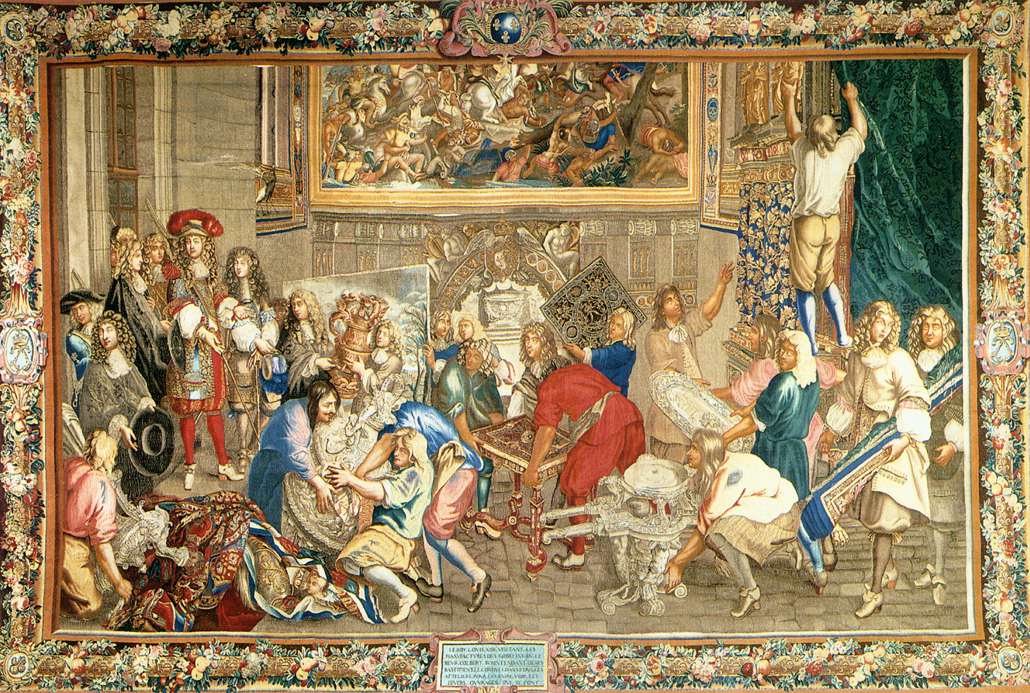
- As a random connection, the same Louis XIV who loved champagne? Also a big fan of the Gobelin factory and scarlet red clothing. He ended up purchasing the factory by a proxy in 1662.
Biblical Red
As an aside, this also explains the constant mistranslation of the (Mediterranean) Biblical Red: תולעת שני (tola'at shani)
which was translated into:
Ancient Biblical Translations
- Septuagint - καὶ κοκκίνου κεκλωσμένου (the celebrated coccus),
- Vulgate - coccoque bis tincto (coccus, double dyed)
Second Temple Commentators
- Josephus (mid-1st century, CE, Rome, The War of the Jews 5:5:4) will say that it resembled "fire".
- Philo (early 1st century, CE, Alexandria, The Midrash of Philo 6:16:13) compares it to "blood".
Targum
- Onqeles (2nd century, Judeo-Aramaic) - צְבַע זְהוֹרִי - saffron
- Rasag (10th century, Constantinople, Judeo-Arabic) - צבג קרמז - kermes
- Peshitta (Christian, Syriac, 5th century) - ܘܨܽܘܒܥܳܐ ܕܰܙܚܽܘܪܺܝܬܳܐ. - וצܽובעܳא דܰזחܽורܺיתܳא. - saffron
Medieval Biblical Translations
- Wycliff (1382) - `reed selk twies died (red silk twice dyed)
- Douay Rheims (1609)- ſcarlet twiſe died (scarlet twice dyed)
- King James Version (1611) - scarlet
- Geneva - English (1599) - scarlet
- Pierre de Vingle (Geneve, 1535) - de l'escarlate, du vermeil (scarlet, vermillion)
- Martin Luther (1545) - Scharlach (scarlet)
- Coverdale (1535) - scarlet, purple
- The Great Bible (1539) - skarlet (scarlet)
- Bishop's Bible (1568) - scarlet
- Matthew's Bible (1537) - scarlet, purpull
Notes:
1. Onqeles and the Peshitta both use a similar root (z-h-r) is a light word based on "shining, radiance, glowing". It is often interpreted as either saffron or kermes, but is not referring in itself to the kermes dye. In Syriac, kermes would be ܩܪܡܝܙܐ (קרמיזא) or qirmīzā.
2. The translations which include two colors, it's because they had assumed that argaman was scarlet, and that tola'at shani was either purple or vermillion. Ironically, de Vingle's 1535 translation was probably most correct with regards to the latter.
 Ezra Butler
Enjoyed this newsletter?
Please consider making a small one-time tip to help support my research.