The Thought of Gold
WebColors_Final_FINAL.newsletter
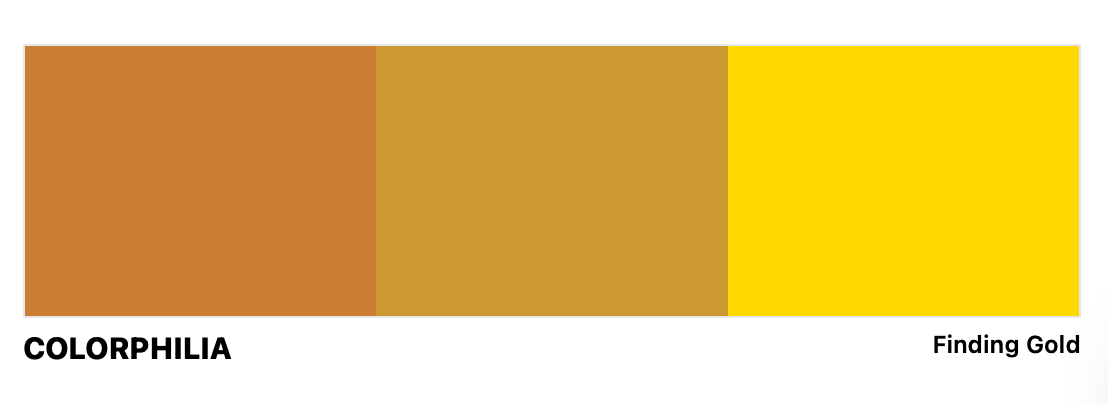
Over the past few month, I've been researching the origins of web colors, and I observed an interesting pattern. While I was able to identify perfectly calculated and logical origins for the inclusion of most of the initial 140 colors, I kept identifying outliers which didn't fit the models.
The main outliers were in four colors: Gold, Silver, Indigo, and Crimson.
This list of four colors is more likely to belong in a work of biblical scholarship than a newsletter about web colors, which makes the coincidence even more confounding.
What this list tells me is that there was another model at work. In additional to all the mathematical models, this model was psychological in nature.
It is regarding the effect of money on research.
Money corrupts? In this economy??
There is a phrase in the Babylonian Talmud which means "money legitimizes the illegitimate" (literally "silver purifies the bastards"). Whether it is intended to be an objective statement of fact or simply a subjective observation of reality, it does not tarnish its uncomfortable truth.
Money corrupts.
I don't only mean with blatant bribery. Even in something as pure as research, there is a tendency to believe that if someone funds research, it will somehow alter the results. Sometimes this is explicit, other times implied.
We run into a problem of circular reasoning.
Research needs funding, but if the "wrong" people fund research, the funding will cast aspersions upon the results of the research. Moreover, with ample funding, it more likely that that research will be widely distributed, and the researchers will receive speaking engagements, invitations to exclusive dinners, book deals, awards, and funding for more research.
One need not look beyond the current scandals in the news regarding academics who were seduced by the so-called filthy lucre. It is beyond the scope or desire of this newsletter to expound on this.
Not a mea culpa
This is not a mea culpa regarding Colorphilia. While I'm grateful for the handful of paid subscribers, and would be even more grateful for a few more, for better or worse, my research is driven by my own curiosity.
As I noted earlier this week, if you choose to upgrade to a paid subscription, or if you already have a paid subscription, you can choose to ask me to research something that you are curious about. While I may choose (or not) to share that question and answer with the larger list, I will try my best not to allow $60 to corrupt my research.
Or if you would like get a free subscription and consider giving a one-time tip of whatever amount you like. $10 will definitely not corrupt my research.
Subconscious Corruption
The psychological model we find here is not necessarily, illegal, illicit or immoral, but which underscore the implicit questions which pervade the results of most funded research. Namely, how much does even the thought of money alter the results of research?
Gold
In my analysis of the VT-240 colors, I discovered that out of 64 colors, the only one to not fit within the various formulaic calculations was the color gold. It seems like the researchers at DEC (Digital Equipment Corporation), the company who made one of the first color monitors in the early 1980s, ran their calculations, named the colors they created to the best of their abilities, and in a single case, gold, decided to shift its hue back 10°, from 160° to 150°. It is nearly imperceptable, unless you happen to notice the numbers.
They took a mathematically pristine palette, chose to assign an arbitrary color name of gold, and then the mere idea of gold drove them to want to find a slightly better shade.
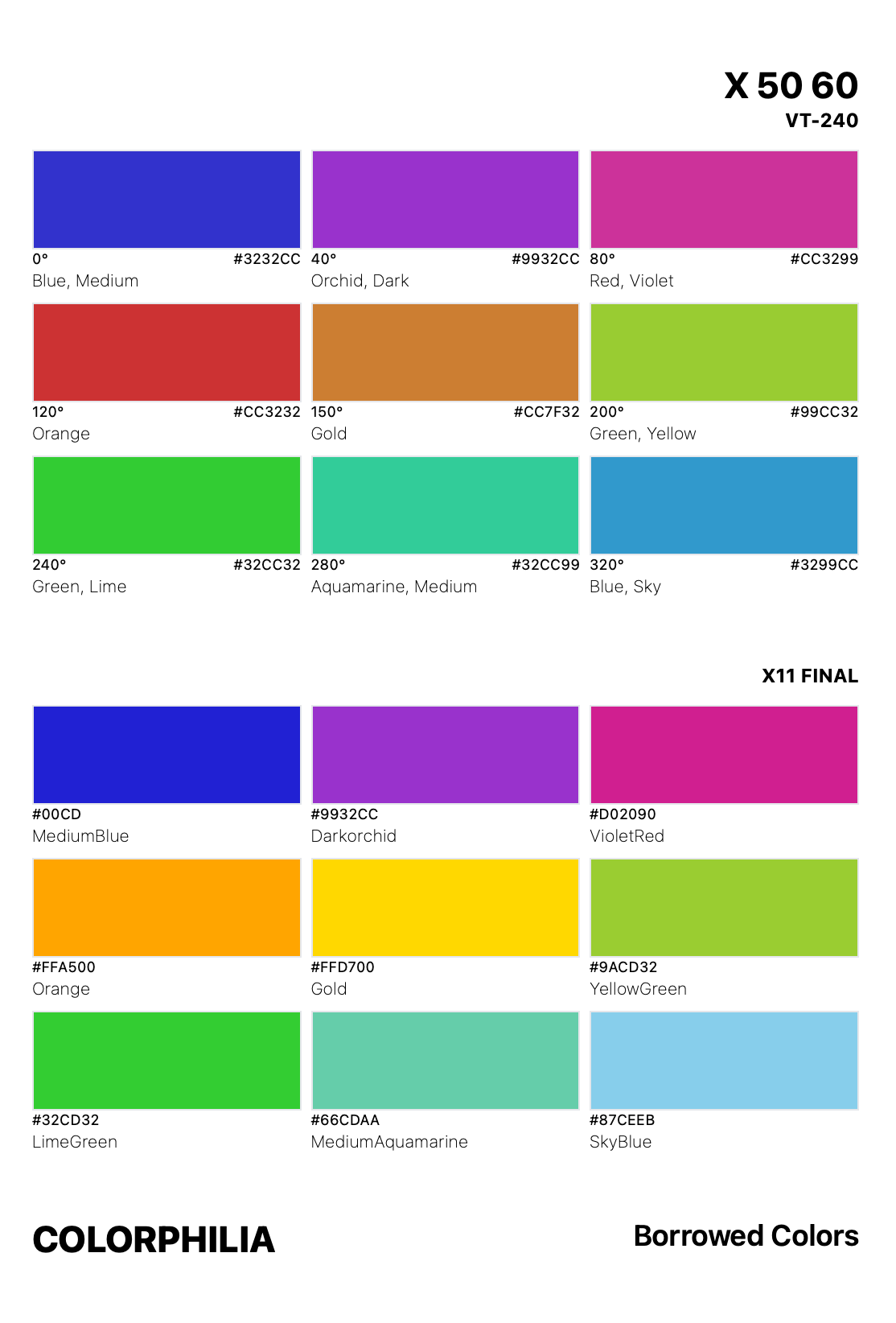
As far as I know, no one ever realized, and no one really cared. It doesn't really affect anyone, but it betrays the effect of human psychology on something which can otherwise be described as completely objective.
 Ezra Butler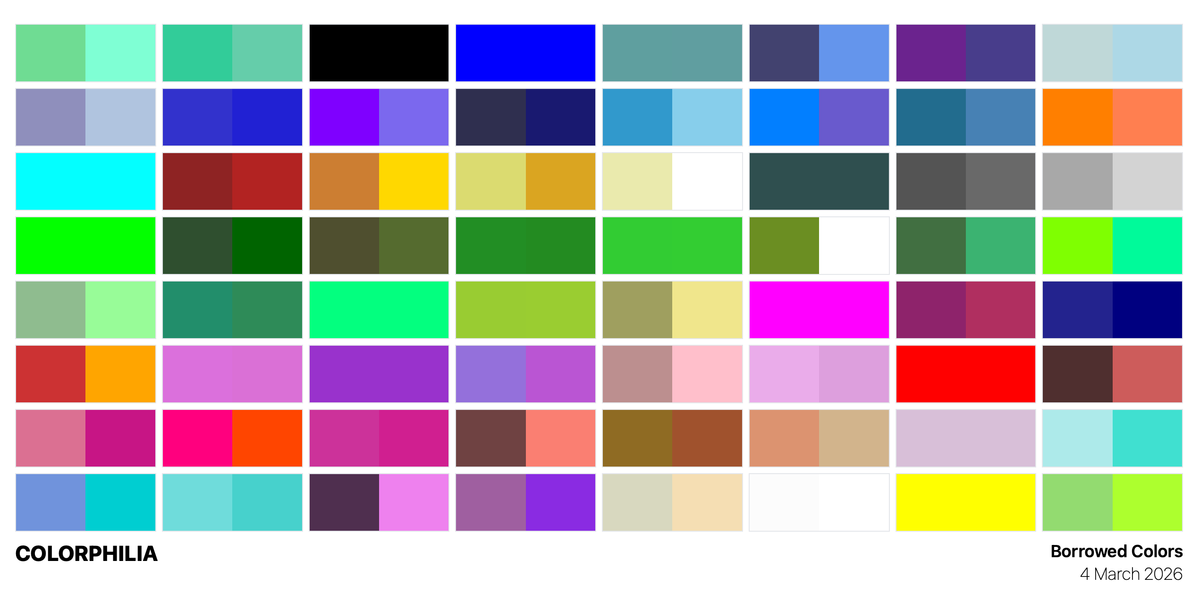
Silver
When I analyzed the 16 HTML4 colors, I noticed that 15 out of 16 of them fit the same model. The only one which did not fit was the color "silver". What's even more is that it would make more sense to describe the shade as "light gray". As all the other color-names were single words, I completely understand why they sought a suitable single word color-name to describe this specific color.
Their decision was completely independent of the above-mentioned VT-240 gold shift, and this wasn't some huge conspiracy, it was simply a byproduct of human psychology, even in a not-for-profit organization like the W3C.
Indigo and Crimson
Indigo and crimson were the only two color-names added by someone to the Frankenstein-ed X11/HTML4 color list, which ended up as the color-words by all web browsers before and put up for a suggestion in a CSS1 working paper.
My theories about their inclusions are:
1. Indigo was the brand color of SGI, the company which both released a violet-colored Indigo computer and created the first WYSIWYG HTML editor.
2. Crimson is the color of Harvard, and there were Harvard graduates involved in the various companies involved in our story.
Of course, SGI's selection of the name indigo for their product (alongside the brand colors of purple) and Harvard University's adoption of the color crimson can both be viewed through the lens of psychology to highlight their respective elite statuses. Which they were.
 Ezra Butler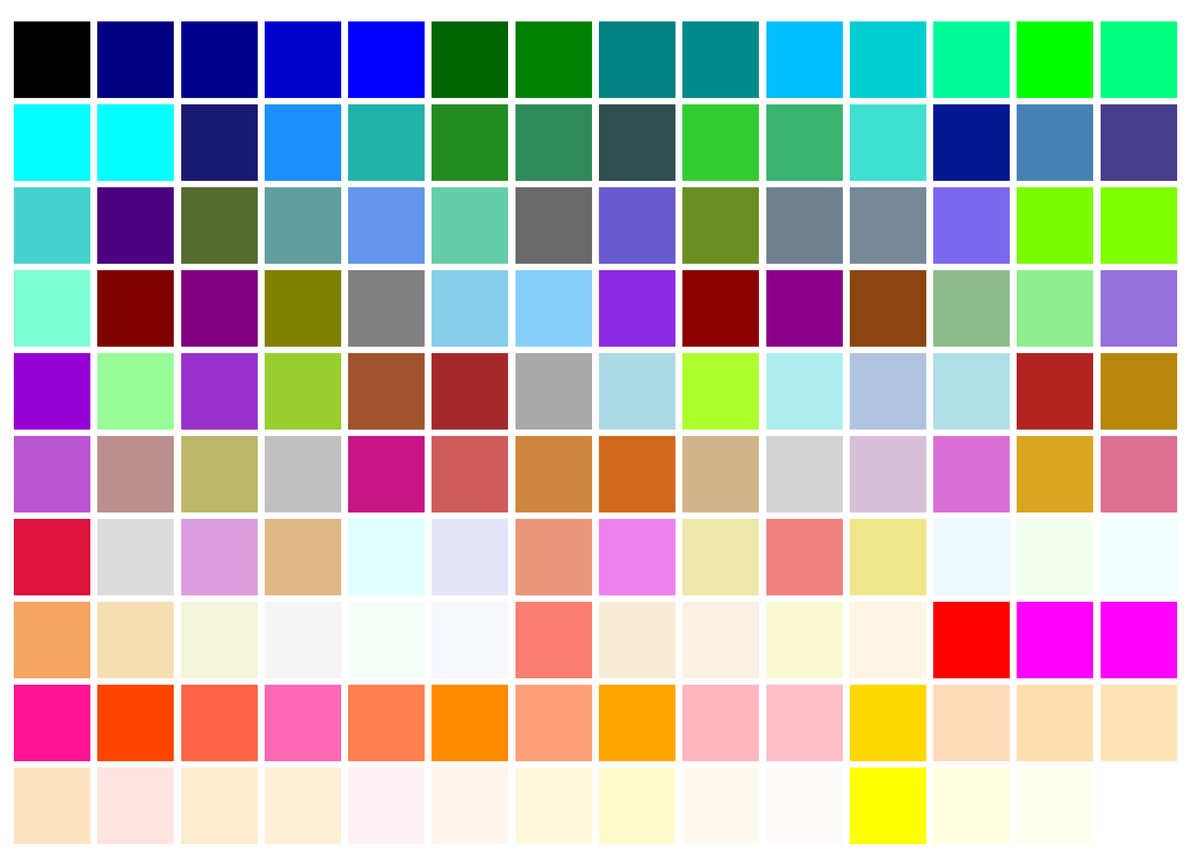
 Ezra Butler
Historical Precedents
Newton
Back in September 2024, my curiosity drove me to analyze Sir Isaac Newton's research into the spectrum of light, and since then I have repeatedly questioned his motivations for including orange and indigo within the spectrum.
 Ezra Butler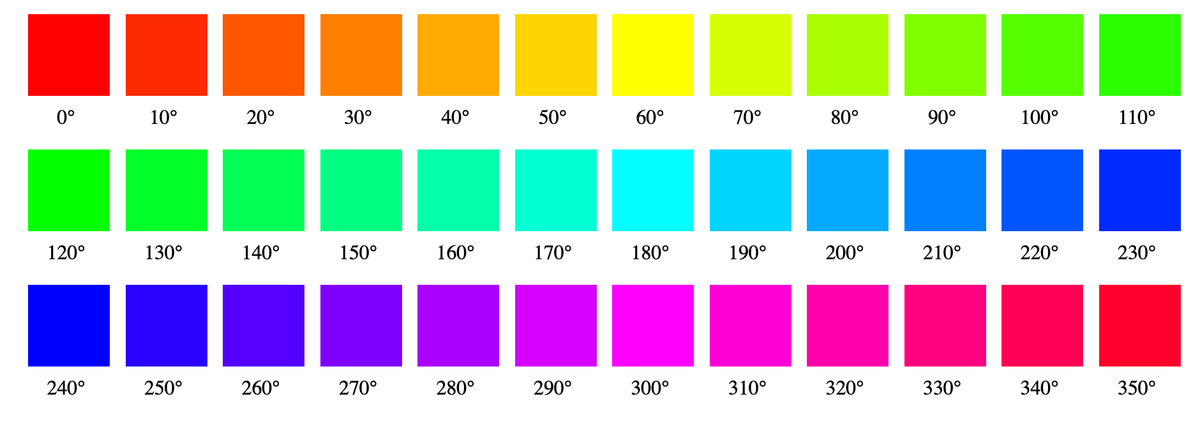
 Ezra Butler
Whether he considered orange as an equivalent of gold or whether he chose orange to honor his patron who made him wealthy, William of Orange, King of England, both still were understandable from a perspective of human psychology.
 Ezra Butler
Similarly, while further research which I did while in London seems to cast doubt on whether Newton was ever an official board member and shareholder of the East India Company, or whether he simply used the resources of the East India Company in order to import large amounts of gold from China for the Mint, he obviously considered indigo to very much a valuable commodity.
Aristotle
Aristotle himself wasn't immune to the allures of riches in his own description of the rainbow. Even though everyone before Newton tended to use three colors to describe the rainbow, Aristotle casually mentioned the color of gold and as an additional descriptor.
As I mentioned in my newsletter on the topic, all the color-words he had employed were, in fact, luxury items, namely: phoenix-tail, leek green, sea-purple, and golden.
 Ezra Butler
Finding Value
As I noted above and frequently elsewhere, I'm not funded. It's not a point of pride. It's one of frustration. I often question if I am actually doing original research, and if I am, is there any value to what I do.
Value is usually assigned by utility, and I am hard-pressed to identify a utility for analyzing the mathematical composition of a list of 42 year old list of colors. Or for deconstructing the compilation of a 30 year old list.
Had I never done spent the past few weeks on these, I would have never identified these four curious exceptions to the list which itself is a critical, and often overlooked, aspect of the history of the web.
Indentifying Utility
Even if we argue the relevance of any or all of these lists, each one represents the same basic thing: attempts at functional sampling.
There are millions and millions of possible colors. How can we create a list of colors which is inclusive enough, but small enough to be useful?
It is the same question I believe that Newton was trying to answer when he applied the formula for the various musical scales. I personally disagree that seven was the correct answer.
Nomenclature
Moreover, even when we find that optimal list, and we have to name the colors, how does that alter things? It seems like in every single interation of this list, people adjusted colors to better match the names they were, somewhat arbitrarily, given.
But in doing so, they were effectively ruining the sampling.
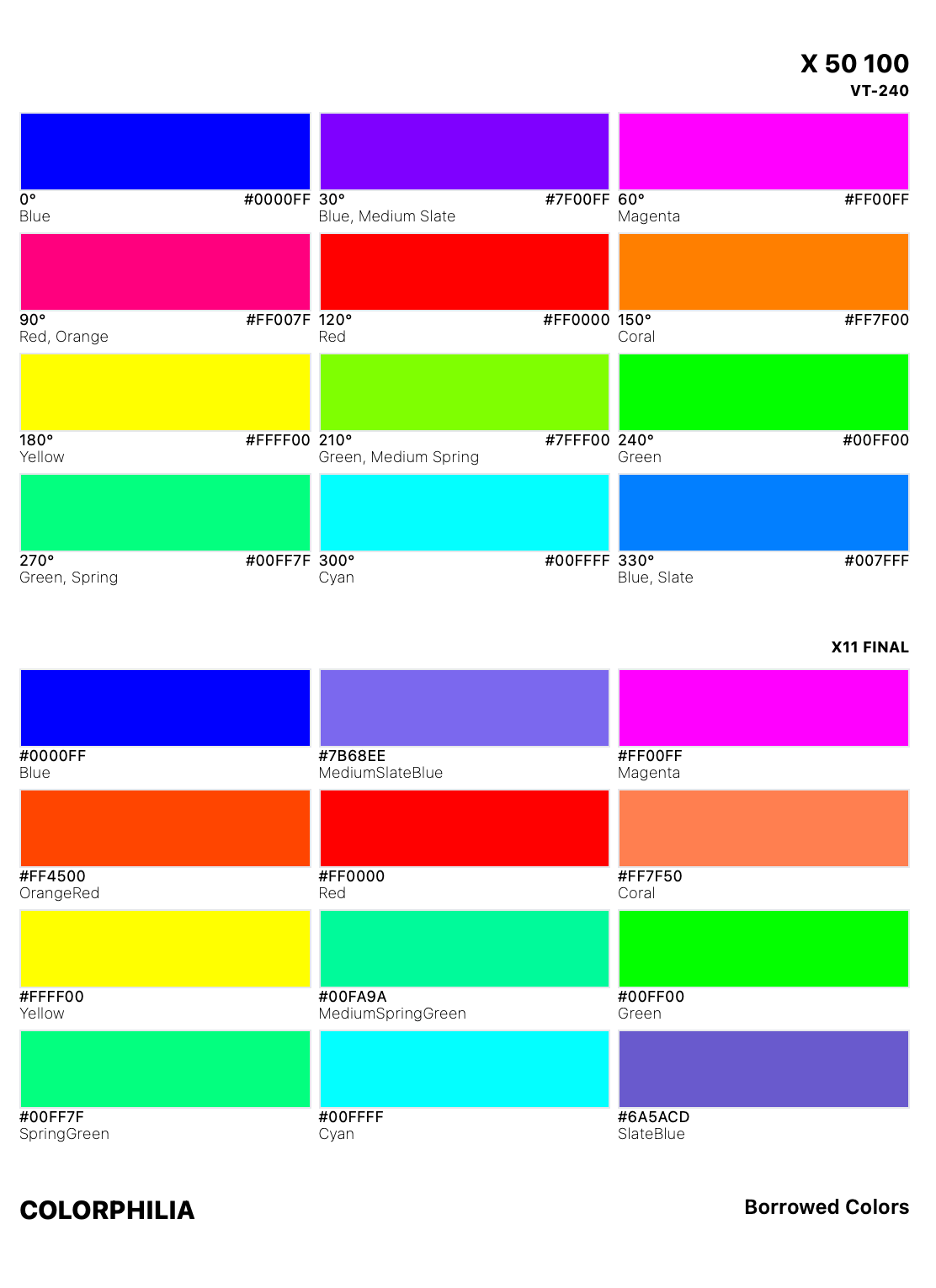
Take the example of the X (H) 50 (L) 100 (S) subset of colors. If we ignore the names, the top list is a pretty good sampling of colors. The green subspectrum is oversampled, simply because green is overrepresented in the spectrum of color.
When people began to fidget with the list to make OrangeRed look more like its name, and Coral not look so orange. Somehow, MediumSpringGreen starts looking teal, and SlateBlue looks purple.
Why
Why name things?
But the point of web colors (from the X11 and on) was the use of color-names to easily describe colors, whereas in the VT-240, they used names simply to make it easier to find the correct HLS code on the list.
On an objective level, the X11 ruined the sampling, but they also tried to make it easier for people to know what color they were writing (or reading) in their code.
The value in asking "Why?" and "How?"
In the newsletter last week, I included an email from the listed creators of one of the lists who wrote:
Looking back I don't even recall why we limited ourselves to 140 entries in that list, it seems like an odd number.
Without re-explaining the entire, purely utilitarian reason for the each of the 140 entries on the list, just the question highlights that they didn't try to understand how any of the colors got there, and why they were included.
To paraphrase the line attributed to Sir Isaac Newton, they stood on the shoulders of giants, but never really thought about how they got there.
If they had, they would have spent a little bit of time optimizing the color list for their own purposes.
By asking how each of these lists was compiled, we are better able to understand the why. And at the end of the day, I would contend that there is value and utility in that.